Last Updated: May 2026. We research independently. Some links are affiliate links — this costs you nothing and helps fund our work.
The standing desk market has grown significantly in the UK, driven by research highlighting the health risks of prolonged sitting. The logical conclusion many buyers draw is that standing is better than sitting and that a standing desk will solve everything.
The reality is more nuanced — and more useful.
Neither sitting nor standing is optimal as a sustained posture. The evidence consistently points to the same conclusion: the problem is not sitting, and the solution is not standing. The problem is staying in any single position for too long, and the solution is regular, deliberate alternation between the two.
Quick links:
👉 Anti-Fatigue Mats on Amazon UK
This guide explains what the research actually shows, what sitting and standing each do well and poorly, and how to build a practical routine that works.
The Core Finding: Movement Is the Goal
| Position | Prolonged Risk | Why |
|---|---|---|
| Sitting | Increased lower back load, reduced circulation, metabolic effects | Sustained lumbar disc pressure |
| Standing | Lower limb fatigue, varicose veins, foot/ankle load, lower back strain | Sustained static muscle contraction |
The consistent finding across ergonomics research is that posture variation — regular changes between different positions — is what the body needs. Neither sitting nor standing is inherently harmful. Sustained, unbroken periods of either one are.
The Real Benefits of Sitting
Sitting gets an unfairly negative reputation. Correct sitting in a properly adjusted ergonomic chair is sustainable, comfortable, and cognitively effective.
| Benefit | Why it matters |
|---|---|
| Lower muscular fatigue | Sitting allows leg/core/back muscles to rest when properly supported |
| Reduced joint load | Less demanding on feet, ankles, knees, hips than standing |
| Stability for detailed work | Better platform for fine motor control, precise typing, sustained concentration |
The problem with sitting is not the position itself — it’s the duration. Sustained sitting beyond 45–60 minutes increases lumbar disc pressure and activates the pattern of muscular fatigue that produces back pain.
The Real Benefits of Standing
Standing desks became popular for legitimate reasons. The benefits are real when the approach is correct.
| Benefit | Why it matters |
|---|---|
| Reduced lumbar disc pressure | Standing distributes spinal load differently, reducing pressure that accumulates through sustained sitting |
| Improved circulation | Better blood flow to lower limbs, reducing leg heaviness and fatigue |
| Increased alertness | Many users feel more energised during standing periods |
| Caloric expenditure | Modest but cumulative over a working year |
The problem with standing is, again, duration. Standing for more than 45–60 minutes continuously produces its own fatigue, increases load on lower limbs, and can cause its own form of lower back discomfort.
Direct Comparison
| Factor | Prolonged Sitting | Prolonged Standing | Alternating |
|---|---|---|---|
| Lower back load | High | Moderate | Low |
| Leg fatigue | Low | High | Low |
| Circulation | Poor | Good | Good |
| Cognitive focus | Good | Moderate | Good |
| Caloric burn | Lower | Higher | Moderate |
| Joint load | Low | High | Low |
| Long-term sustainability | Poor | Poor | Good |
The pattern is clear. Neither sustained sitting nor sustained standing performs well across all factors. Alternation performs well across all of them.
The Optimal Sitting-to-Standing Ratio
Research on optimal sit-stand ratios consistently suggests:
For every hour at the desk: approximately 45 minutes seated and 15 minutes standing
In practice, the exact ratio matters less than the consistency of switching.
A practical approach that works:
| Step | Action |
|---|---|
| 1 | Stand for the first 15 minutes of each hour |
| 2 | Sit for the remaining 45 minutes |
| 3 | Take a brief walk or stretch at the transition point |
| 4 | Use memory presets so switching takes one button press |
The key friction point is switching itself. Without memory presets, most users find the effort of manually adjusting desk height a sufficient barrier that they stop using the standing function within weeks.
👉 See: Best Standing Desks UK with Memory Presets
Does a Standing Desk Actually Help Back Pain?
For most desk workers with lower back pain, yes — when used correctly.
The mechanism is reduction of cumulative lumbar disc pressure through regular postural alternation, not the elimination of seated posture.
Users who experience the most benefit are typically those who:
Have been sitting for sustained 8+ hour periods without postural breaks
Transition to a deliberate alternation routine
Important caveats:
A standing desk paired with a poorly adjusted chair does not address the seated portion effectively
A standing desk used without an anti-fatigue mat on a hard floor may produce lower limb fatigue that offsets the benefit
👉 See: Best Ergonomic Chairs for Back Pain UK
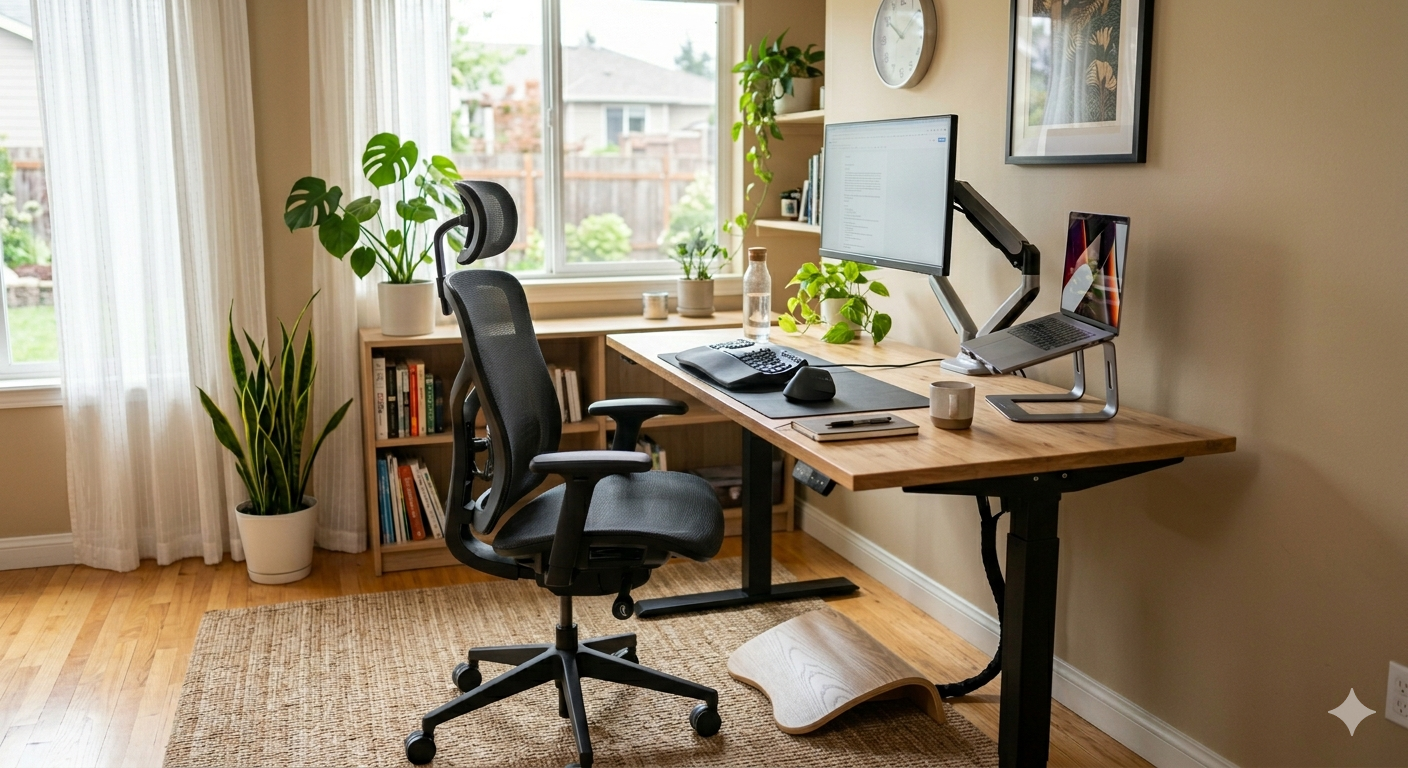
Practical Setup for UK Home Offices
| Step | Action |
|---|---|
| 1 | Get the chair right first. A standing desk doesn’t compensate for a poor chair during seated periods. |
| 2 | Choose a desk with memory presets. Switching must be effortless or the habit won’t stick. |
| 3 | Add an anti-fatigue mat. Small cost that meaningfully increases likelihood of using the standing function. |
| 4 | Set a reminder for the first two weeks. Phone reminder at the top of each hour to switch position. |
| 5 | Start with less standing than you think you need. Begin with 10–15 minutes per hour and build gradually. |
👉 See: Anti-Fatigue Mats on Amazon UK
Is a Standing Desk Worth It in the UK?
| Situation | Verdict |
|---|---|
| Sit 6+ hours daily with back pain, fatigue, or postural problems | Yes – worth the investment |
| Already take regular breaks and not experiencing discomfort | Less pressing – prioritise chair first |
| Have a poor chair | Chair first – delivers more ergonomic benefit per pound |
The combination of a quality ergonomic chair and a height-adjustable desk is the most complete ergonomic solution for a home office.
👉 See: Best Ergonomic Chairs Under £500 UK
Final Verdict
Sitting versus standing is not a competition with a winner. Both are sustainable working positions when used for appropriate durations and with correct ergonomic support. Both are problematic when sustained without interruption for hours at a time.
The correct answer for almost every UK desk worker is deliberate, consistent alternation:
Stand for approximately 15 minutes in every hour
Sit for the remainder
Move briefly at each transition
A height-adjustable desk with memory presets is the tool that makes this habit practical rather than effortful. Pair it with a properly adjusted ergonomic chair and an anti-fatigue mat.
The result is a meaningfully healthier and more comfortable working day than either sitting or standing alone provides.
👉 View Best Standing Desks on Amazon UK
Frequently Asked Questions
Is standing better than sitting at a desk?
Neither is better as a sustained posture. Standing reduces lumbar disc pressure and improves circulation compared to prolonged sitting, but sustained standing creates its own fatigue. The evidence consistently supports regular alternation as the most beneficial approach.
How long should you stand at a standing desk?
Most ergonomics guidance suggests 10–20 minutes of standing per hour as a starting point, building toward approximately 15 minutes standing per hour as a sustainable routine. Extended continuous standing beyond 45–60 minutes produces its own discomfort.
Can a standing desk reduce back pain?
Yes, for most desk workers experiencing lower back pain from prolonged sitting. The benefit comes from reducing cumulative lumbar disc pressure through regular postural alternation. A standing desk paired with a quality ergonomic chair delivers the most complete solution.
Do you burn significantly more calories standing?
The difference is modest — standing burns approximately 8–10 more calories per hour than sitting. Over a full working year this accumulates, but postural and circulation benefits are more significant than weight management.
Is a standing desk worth it for home offices in the UK?
For users sitting 6+ hours daily who experience back pain, fatigue, or postural problems — yes. For users already taking regular breaks and not experiencing discomfort, the chair is a higher-priority investment.
What is the best standing desk for UK home offices?
The MAIDeSITe Electric Standing Desk and FlexiSpot E1 Plus are the strongest options on Amazon UK. See our full guide for detailed comparisons.